
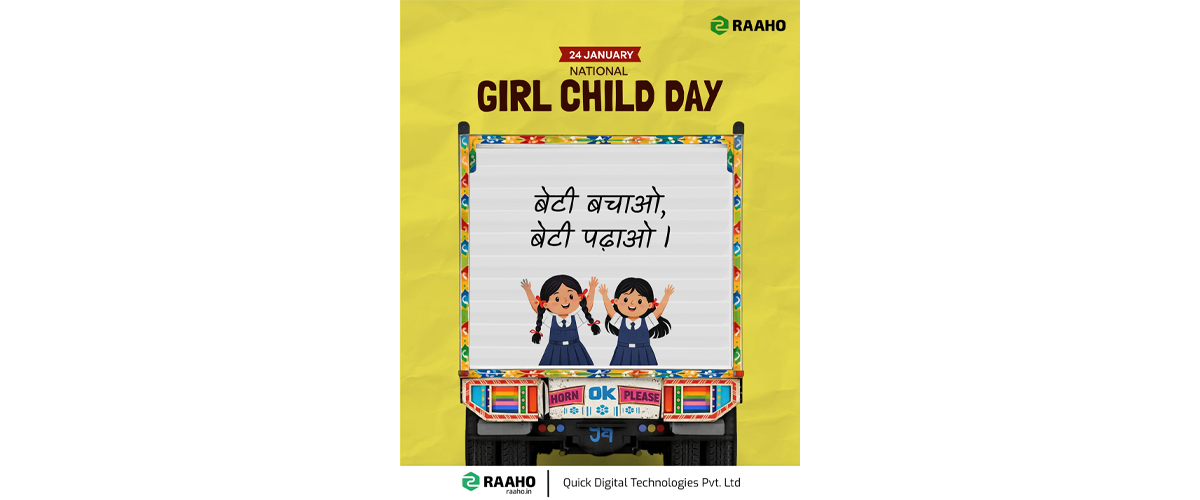
How trucks became an unexpected ally in campaign messaging for Beti Bachao Beti Padhao
Every year on January 24, India observes National Girl Child Day. The day traces back to 2008, when the Government of India formally introduced it to spotlight a hard truth, girls in India were, and in many places still are, fighting for their most basic rights, survival, education, and dignity.
Its significance today hasn’t faded, but it has evolved. Awareness around girls’ education, health, and safety is far stronger than it was a decade ago. Campaigns like Beti Bachao Beti Padhao have helped shift national dialogue from “saving the girl child” to “educating and empowering her.” Enrollment numbers today stand at 48.3% of primary school students. Conversations are louder. Visibility is higher. Yet gaps remain. Cultural resistance still travels quietly, especially across rural and semi-urban India.
And this is where an unexpected ally comes into focus, trucks.
Trucks move messages
India runs on trucks. They move food, fuel, medicine, construction material, and people’s livelihoods across states, districts, and villages. But they also move messages. A slogan painted on the back of a truck can travel farther than a billboard. A line written in bold letters can cross language barriers, highways, and social boundaries.
When trucks carry messages like Beti Bachao Beti Padhao, they take the idea into the everyday lives of millions. Into dhabas. Toll plazas. Market towns. Remote highways where digital campaigns don’t always reach. The truck becomes more than a vehicle. It becomes a moving reminder that progress is everyone’s responsibility.
The slogan “Beti Bachao Beti Padhao” didn’t land on trucks by accident. It arrived there the same way many Indian ideas do, slowly, practically, and because it worked.
The slogan itself comes from the Beti Bachao Beti Padhao initiative launched in 2015 by the Government of India. The aim was to confront two linked problems, saving the girl child and educating her. Policy alone wasn’t enough. The message had to travel.
Long before social media, trucks were India’s original broadcast network.
A single truck crosses states, languages, districts, villages, highways, and city edges in one trip. The back of a truck is read by pedestrians, shopkeepers, toll workers, commuters, farmers, children waiting for buses. Few communication channels in India have that kind of reach.
Government awareness drives encouraged public display of the message. Regional transport offices and local campaigns promoted it during repainting and registration. Truck owners and drivers adopted it, sometimes encouraged, sometimes voluntarily, because it carried moral weight and social respect. Painters and workshops began offering it as a standard option, the way certain designs become defaults. Over time, it stuck. Not as an order, but as a cultural layer.
Trucks represent livelihood, movement, and responsibility.
Putting Beti Bachao Beti Padhao on a truck quietly links progress to motion. The idea that the country can’t move forward if half its children are left behind. It’s symbolic, but grounded. Very Indian that way.
So when you see that line rolling past you on a dusty highway or a city flyover, you’re not looking at branding. You’re looking at a message that learned how India actually listens. Not in hashtags first, but on the road, kilometer by kilometer.